Abstract
Full Content
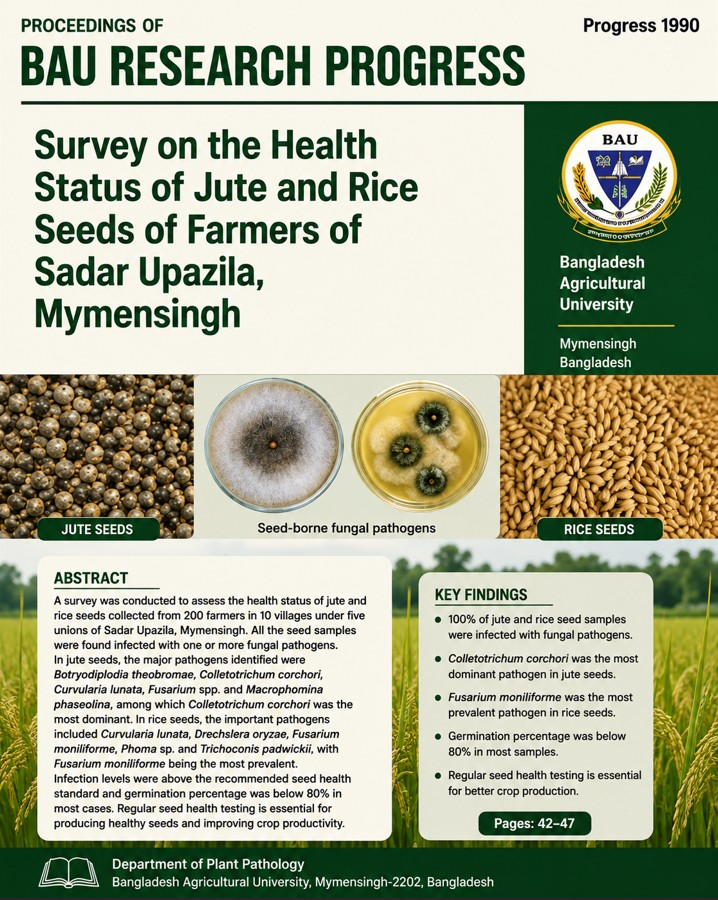
This study investigates the health condition of jute (Corchorus capsularis) and rice (Oryza sativa) seeds collected from 200 farmers across 10 villages in five unions of Mymensingh Sadar Upazila.
The findings reveal that all seed samples were infected with one or more fungal pathogens. In jute seeds, major pathogens identified include Botryodiplodia theobromae, Colletotrichum corchori, Curvularia lunata, Fusarium spp., and Macrophomina phaseolina. Among them, Colletotrichum corchori was the most dominant.
In rice seeds, pathogens such as Curvularia lunata, Drechslera oryzae, Fusarium moniliforme, Phoma sp., and Trichoconis padwickii were detected. Fusarium moniliforme showed the highest prevalence.
The study highlights that infection levels exceeded recommended national seed health standards, and germination rates were below 80% in most cases. The research emphasizes the importance of routine seed health testing to improve crop productivity and disease control.